Updated June 9, 2026 by John M. Collins
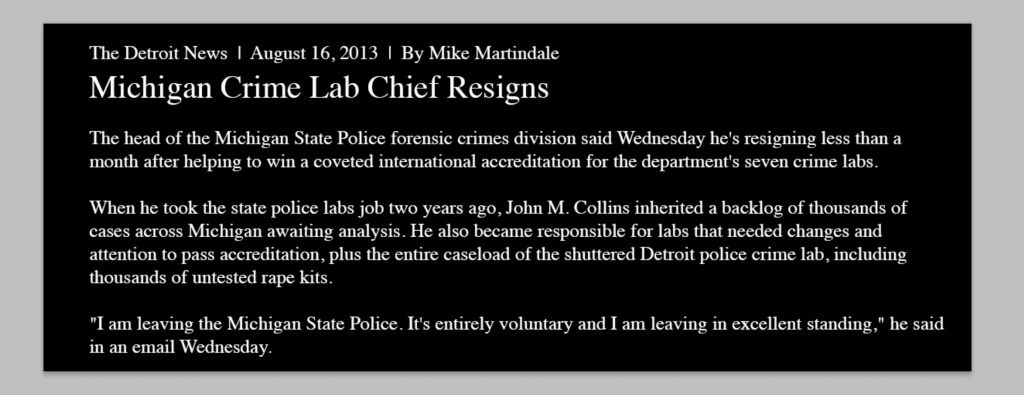
It was August of 2012, and the lead story in the Metro & State section of The Detroit News read “Michigan Crime Lab Chief Resigns,” with a color picture of me in a gray suit, yellow tie, and smile on my face.
The report by Mike Martindale was both an emotional relief and a sobering reminder of the life changing decision I had just made.
Martindale had a reputation of being tough on the Michigan State Police, and the resignation of the top forensic administrator after only 2 1/2 years on the job was an opportunity to stoke another fire. But Martindale was fair and truthful, capturing the array of conflicting factors that made my decision such a difficult and surprising one.
My departure from one of the most prestigious positions in all of forensic science came as a shock to everyone in the Michigan State Police and everyone in the Michigan laboratories. But it did not come as a shock to those who knew me best. Some were surprised it took so long.
My Story and the Critical Victories to Come
A Mess for the Ages
When the opportunity came for me to return home to the state in which I was born and raised, the Michigan criminal justice system had reached a point of utter disarray, with no obvious accountability for why it had gotten so bad. In fact, close friends and colleagues tried to talk me out of it, warning me that I would be walking into a hornets nest, and they were right:
Over 11,000 rape kits with unknown investigative dispositions had been discovered in a makeshift storage facility maintained by the Detroit Police Department – rape kits that now needed laboratory testing.
Governor Jennifer Granholm ordered the layoff of over 40 newly-minted troopers who’d recently graduated from the MSP academy. In their place, forensic scientists were hired to test the rape kits. The decision created a devestating internal cultural revolt by the enlisted ranks against the forensic laboratories, making it feel like the labs had to battle their own command structure just to survive.
The Detroit Police Forensic Laboratory was shuttered after 80 years of service. The decision, in my opinion, was the result of a stunning lack of leadership that prevented a more thoughtful and creative solution to dealing with some quality assurance problems that emerged.
After the closure of the Detroit lab, criminal evidence flooded into the doors of the Michigan State Police laboratories, resulting in an explosion of backlogs that caused lengthy delays in the testing of evidence;
The old Detroit lab was literally abandoned, leaving behind a hazardous waste scene with chemicals and expensive equipment exposed to both the elements and curious trespassers. Later, when I went to visit the site dressed in a hazmat suit, it looked like the scene of a science-fiction apocalypse.
But I took the job anyway, and for good reasons. Not only was it an amazing opportunity to serve my home state doing what I loved to do, my parents who lived in the Detroit suburbs were dying and needed my help.
My eventual resignation came at an odd time. My executive team and I had just led the Michigan laboratories to their first ever international accreditation, a monumental achievement considering all of the fires we were fighting along the way. It also marked the end of my award-winning 20-year career working in federal, state, and local crime laboratories. By that time, I had emerged as a trusted voice in forensic science and a mentor to many other forensic scientists and forensic laboratory administrators across the United States.
But in my early 40s, with two young children and a mortgage, I reached what felt like an impenetrable barrier that was keeping me from doing my job the way I knew it needed to be done.
So I decided that it was time to walk away. And the reason I walked away was not necessarily because of the challenges that my team and I were confronting on a daily basis, but rather because of a principle of success that I now share with almost every client and almost every audience with whom I engage:
“True success requires that your intentions be more powerful than your circumstances”
When those moments arise that we must reevaluate our intentions, then we have to do it. If we have no choice but to change the nature of the circumstances we face, then we must do that too, as I did. But we can never allow ourselves to languish for too long in a chronic state of reaction. Reactivity makes us feel like spectators in the game of life. Intentions, however, make us feel like players, giving our lives purpose, meaning, and direction.
10 Years and Counting
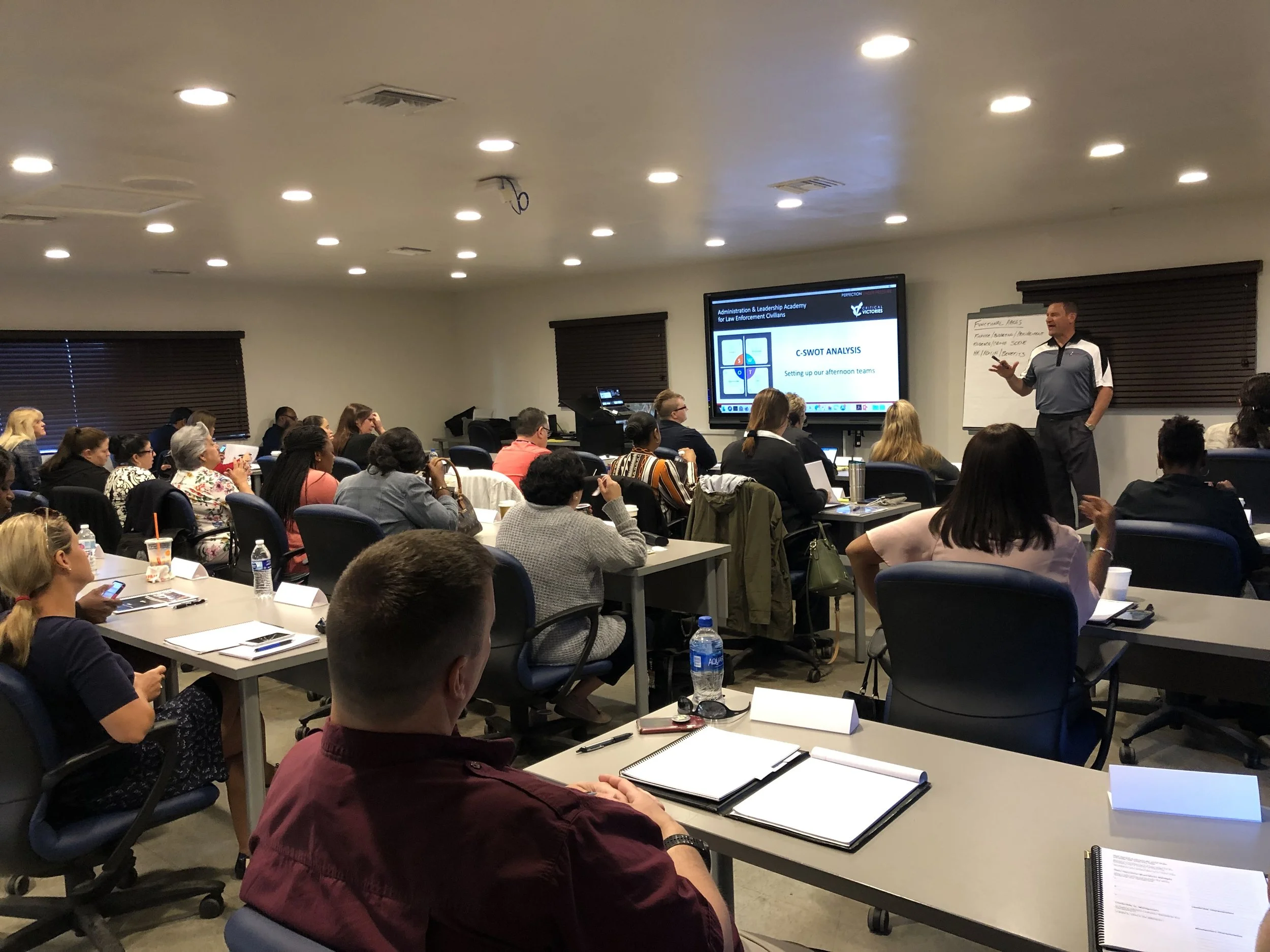
My name is John Collins and I am a professional coach. I specialize in working with leaders and professionals in authoritative, high-consequence occupations that impact the quality of people’s lives. Because of my criminal justice background, the majority of my coaching and training clients come from forensic science laboratories and law enforcement agencies. I also work with clients in other high-stakes occupations that require high levels of expertise and stress tolerance.
I live and work near Detroit, Michigan where I was born and raised. As I sit in my office and reflect on the fateful decision I made ten years ago to start my private coaching and training practice, I realize that it’s the first time I’ve reflected with any depth on the importance of my choice to take my career in a radically different direction.
Since then, I’ve conducted business in 44 of 50 states and engaged with tens-of-thousands of clients, workshop attendees, and audience members. I’ve written and published five books; I’ve worked directly with clients overseas in Africa, Asia, and Europe – including an officer in the Iraqi military; I’ve taught and lectured at major universities and I’ve been hired to work with teams and individuals in six U.S. federal agencies.
Yet my recollections also include the fear and doubt I coped with during my journey. This is to say that the decision to start my own business as a full-time commitment was emotionally and financially draining, and there were days when I didn’t know if it was going to allow me to make a living. Although I believed in myself and the things that were important to me, I wasn’t sure it would be enough.
But then, just in the nick of time, came one defining moment that served to remind me that I was doing the right thing and that everything would be okay.
When the FBI Calls
It came in the form of an invitation by the executive command office of the FBI Laboratory near Washington, DC, the largest and most respected forensic science laboratory in the world. They asked if I would be interested in giving a motivational speech to their employees, explaining that their team had been dealing with an especially challenging situation that was taking a toll on their morale and sense of wellbeing.
I accepted the invitation and delivered my speech before sitting down for lunch with the laboratory’s director and his executive team. They shared with me some of their unique challenges and opportunities, explained some of their innovative research priorities, and then gave me a tour of the laboratory.
As my visit drew to a close, it finally dawned on me: This was a very special day. It was evidence that I was reaping the rewards of that very special decision I made that was now allowing me to do very special work with very special people who have a very special impact on our society.
Critical Victories
The name of my practice is Critical Victories, and I am frequently asked what a critical victory is.
A critical victory is an urgency that you choose to create and prioritize above almost everything else in your professional span of control. It is the crisis you elect because you know that by meeting its demands, it will forever strengthen you as a person, professional, team, or organization.
We all know that crisis descends upon us without warning, those sets of circumstances that arise without our asking for them, yet we find ourselves better for the experience. So it makes sense that, whenever possible, we be intentional about creating the urgencies of our choosing before we are met by the ones we rather not have.
It is these critical victories, these triumphs of intention over circumstance that ultimately shape the direction of our lives and careers, and the impact we will have on others along the way.
In my fourth book, The New Superior – A Better Way to Be the One in Charge, I go into more detail about why I made such a dramatic change in my career trajectory, and I share some of the unique and profound lessons on leadership and organizational culture that my career in forensic science forced me to consider. I promise that if you choose to read it, you won’t be disappointed.
I consider myself a very lucky guy with a very important mission. And what makes this mission so meaningful is that it prioritizes my service to people who matter so much to the world around us. By supporting them in the execution of their missions, I get to change the world one leader at a time.
Ten years ago, I made the decision to prioritize my intentions over my circumstances. It was painful and scary, but it was a critical victory in both my life and career that I needed to win.
I did, and you can too.