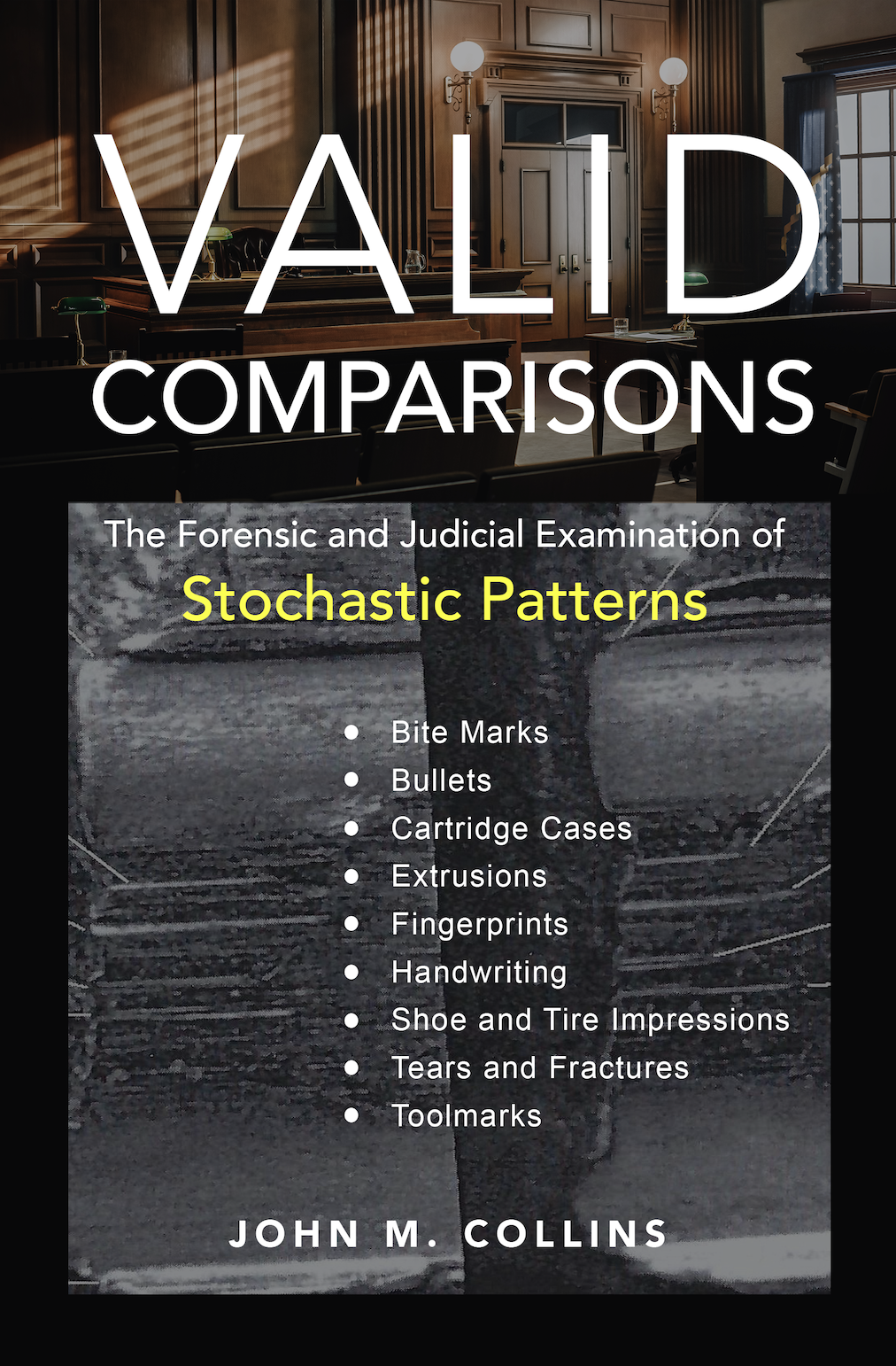
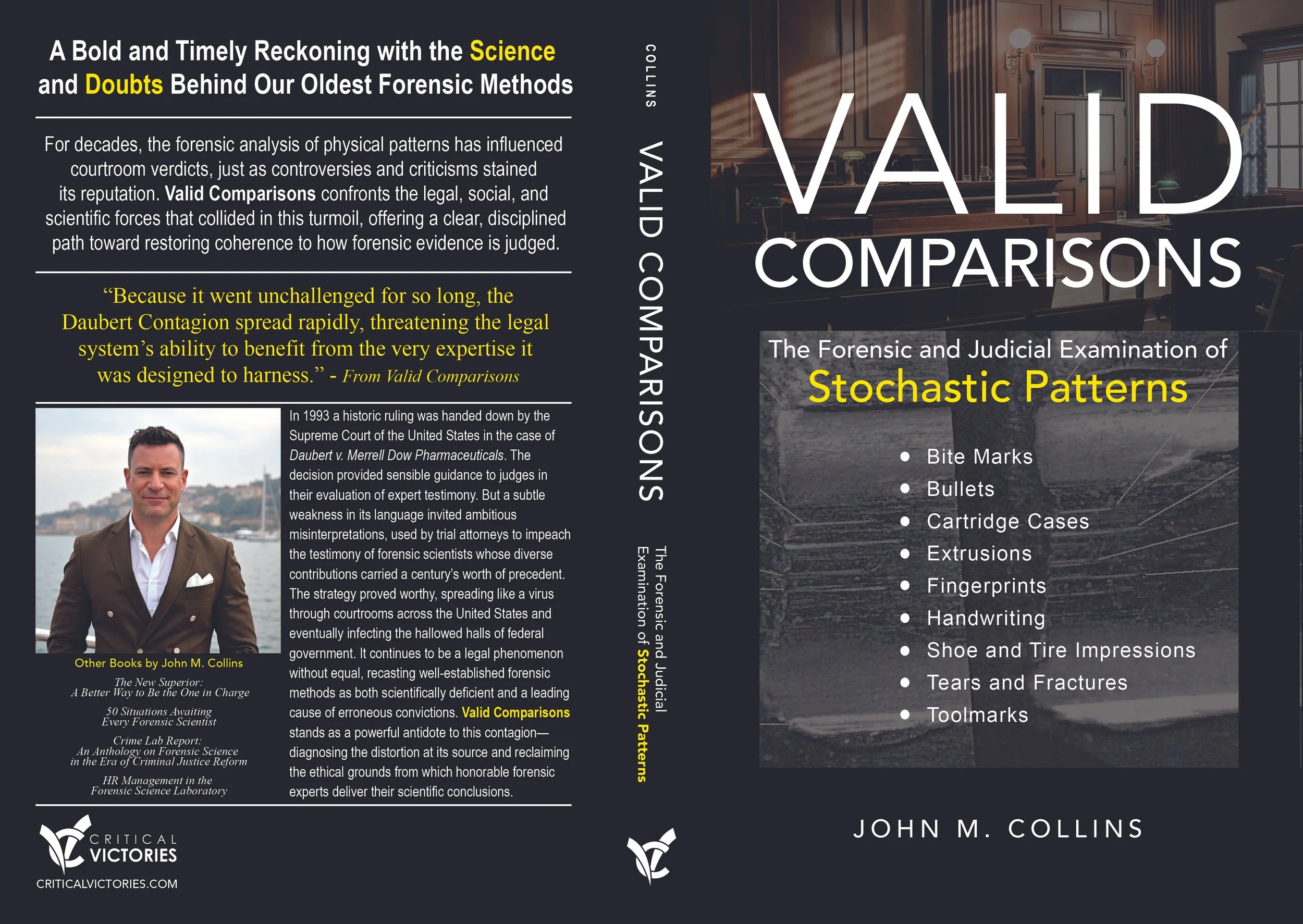
Valid Comparisons - The Forensic and Judicial Examination of Stochastic Patterns (2026)
When a bullet exits a gun, a fingerprint is left on a surface, or a signature is forged, the physical traces left behind become the only witnesses to events that unfolded in secrecy. For more than a century, forensic examiners have learned to read these patterns―to interpret them consistently, carefully, and with consequences that can mean the difference between justice and its failure. Forensic patterns are often a final scientific record of real lives, examined by professionals whose work carries a weight that few outside the discipline fully appreciate.
In Valid Comparisons, John M. Collins draws on more than three decades of experience at the intersection of forensic science and the American justice system to deliver a rigorous, unflinching examination of what has gone wrong―and what must be corrected―in the courtroom treatment of forensic pattern evidence.
Excerpt from Valid Comparisons
“Each of the forensic patterns described in the previous chapter shares a common characteristic. They are produced by randomly occurring forces that cannot be replicated or controlled, born of natural or incidental processes that fall entirely outside the boundaries of human design or intent. To the extent they have forensic value, meaning they can be used to resolve disputes or solve crimes, these patterns exhibit features that may render them unique to a specific source. Many crimes are committed beyond the view of witnesses, but these forensic patterns bear witness to phenomena of unimaginable complexity. It is this complexity, however, that can also help to tell the story of what happened and who is responsible.”
A Unifying Scientific Framework
The forensic laboratory sciences have traditionally been arranged into “disciplines,” each having its own methods, culture, and language. As a result, their scientific maturation occurred independently of one another, without ever fully recognizing or embracing the underlying scientific foundations they share. In the last 50 years, however, computational power has made it possible to explore some of the most complex, random phenomena, such as fluctuations in stock prices or where a hurricane is likely to make landfall. “The science of randomness,” known as stochastics, has been alive and well in forensic science for decades, and this realization helps explain why, in particular, the forensic pattern disciplines are, in fact, valid and worthy of the courtroom respect they’ve enjoyed for over a century.
New!Confronting the ‘Junk Science’ Strategy
Excerpt from Valid Comparisons on the Perpetual Reform Narrative - Page 301
“As the standardization movement accelerated, its effects extended beyond efforts to improve practice. The forensic disciplines increasingly came to be treated as subjects of continuous regulatory evaluation, with no clearly articulated endpoint. Framed this way, forensic science appeared perpetually provisional—always under assessment, always awaiting further validation. In courtroom settings, this posture carried legal consequences. Methods could be characterized as still developing. Testimony could be described as being offered without justification. The disciplines themselves could be presented as institutionally unsettled, not yet having reached professional maturity. Whatever the motivation, the result was a recurring narrative in which forensic science was positioned as perpetually incomplete and, therefore, perpetually vulnerable to judicial or legal rejection.
“To the extent this was an intentional tactic on the part of innocence advocates, it carried legal weight but also costs. It blurred the line between genuine scientific validity and the superficial appearance of reinvention.”
Original Concept Paper (2009)
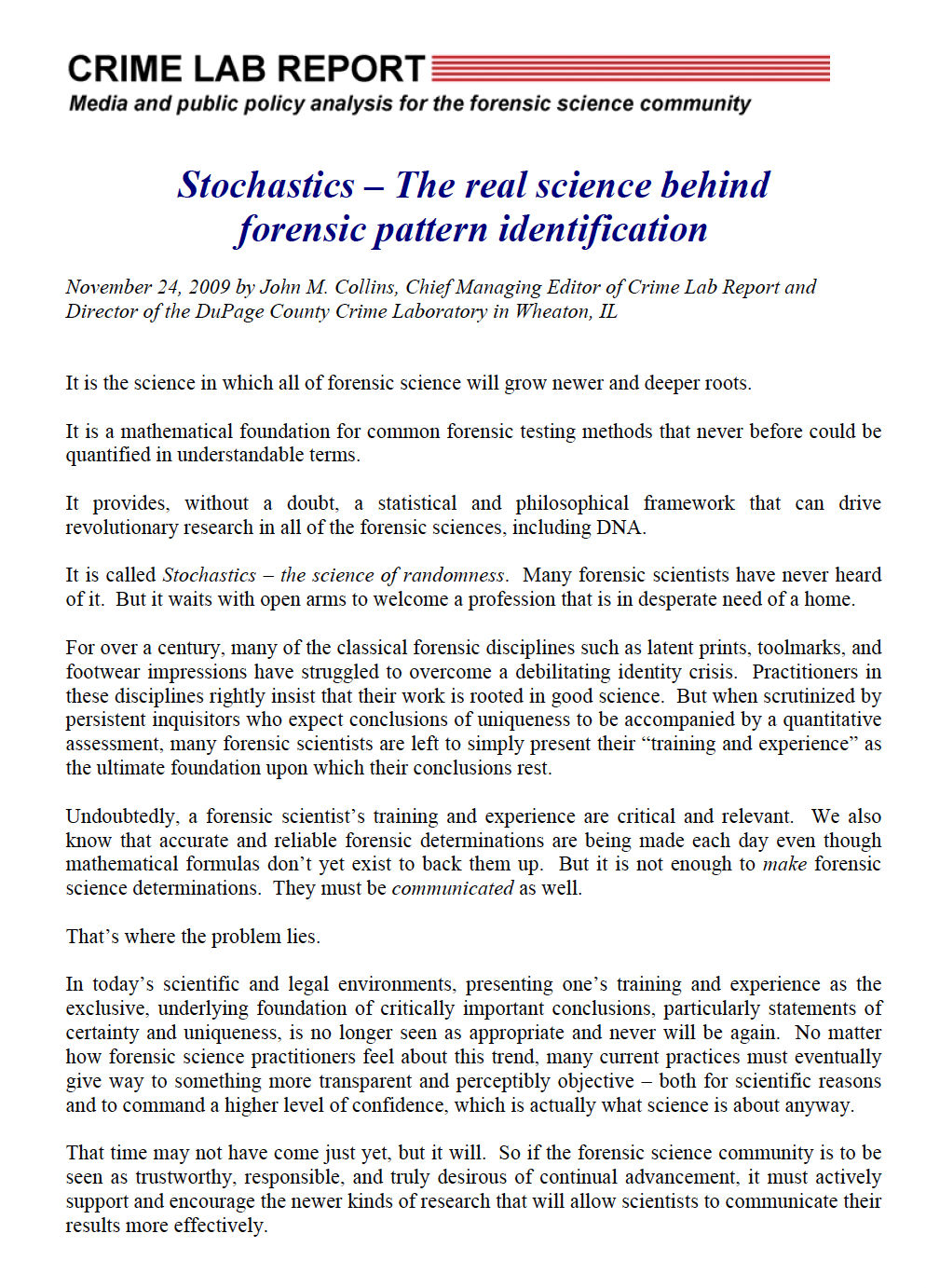
The original conception of Valid Comparisons began to emerge with an article that was written and published by Collins in 2009. It took 17 years for the resulting book to be published. Click below to read “Stochastics - The real science behind forensic pattern identification,” by John M. Collins.
Excerpt: “For over a century, many of the classical forensic disciplines such as latent prints, toolmarks, and footwear impressions have struggled to overcome a debilitating identity crisis. Practitioners in these disciplines rightly insist that their work is rooted in good science. But when scrutinized by persistent inquisitors who expect conclusions of uniqueness to be accompanied by a quantitative assessment, many forensic scientists are left to simply present their “training and experience” as the ultimate foundation upon which their conclusions rest.”
Notify the Author
The author seeks to ensure that Valid Comparisons serves the interests of all forensic laboratory experts and the criminal justice system they serve. To the extent that any errors, omissions, or confusing information are contained within the book, a record at the bottom of this page will contain the author’s official advisories until a new edition can be published.
Readers are encouraged to submit notifications to the author about any potential problems with the book or opportunities to improve the next edition. Submissions motivated by ideology or zealous legal interpretations without any factual basis will not be included in the record.
Chapter and Section Outline
Dedication to John Murdock
Author’s Note
Foreword by Jennifer K. Cones
Part 1—Professional and Scientific Principles
1 Prologue—A Pattern of Evidence
2 An Overview of Forensic Patterns
2.1 Bite Marks and Dental Records
2.2 Extrusions and Surface Impressions
2.3 Fired Bullets
2.4 Fired Cartridge Cases
2.5 Friction Ridges and Latent Prints
2.6 Handwriting
2.7 Footwear and Tire Impressions
2.8 Lip Prints
2.9 Tears and Fractures
2.10 Toolmarks
2.11 Patterns That Tell Unspoken Stories
3 An Inconceivable Science
3.1 Questions of Infinite Difficulty
3.2 Where Science Falls Apart
3.3 Forensic Patterns
3.4 The Shuffled Deck Experiment
3.5 Permutability of Forensic Patterns
4 Stochastics—The Science of Randomness
4.1 The Science of Randomness
4.2 Disconnected Histories
4.3 Class Characteristics
4.4 Individual Characteristics
4.5 Subclass Characteristics
4.6 How Early Forensic Pioneers Got It Right
4.7 Stochastics in Contemporary Society
4.8 Returning to the Shuffled Deck
4.9 Looking Ahead
5 Legal and Judicial Perceptions
5.1 The Frye Standard
5.2 Rule 702 and the Codification of Expertise
5.3 The Daubert Decision
5.4 Impact on Forensic Testimony
6 The Daubert Contagion
6.1 A Dent in the Forensic Armor
6.2 The Death Penalty Context
6.3 The Error Rate Problem
6.4 The Daubert-702 Axis
6.5 Oregon v. Adams (2025)
6.6 A Systemic Infection
7 False Authorities
7.1 The Innocence Project Report
7.2 NAS and PCAST Reports
7.3 Proof of a Misguided Mission
7.4 A Better Example—NIST Scan of 2023
7.5 The Danger of False Authority
8 The Clinical Myth
8.1 An Invalid Comparison
8.2 The Reality of the Forensic Environment
8.3 A Final Reckoning
9 Expression of Conclusions
9.1 Question Dependency
9.2 Range of Conclusions
9.3 Contextual Threats
10 Validity of Pattern Individualization
10.1 In the Wake of Daubert
10.2 United States v. Tibbs (2019)
10.3 Science is the Servant, not the Customer
10.4 The Ultimate Reliability Question
10.5 Valid Identifications
11 Junk Science
11.1 Science is Never Junk
11.2 Origins of the Term
11.3 Junk Science and the Daubert Contagion
11.4 Bite Mark Individualization
11.5 Exonerations and the “Junk Science” Strategy
11.6 Reframing a Junk Narrative
12 Scientific Validity Advocates
12.1 Science and the Temptation of Activism
12.2 How Activism Compromises Gatekeeping
12.3 Contemporary Examples
12.4 A Case Study
12.5 Distinguishing Experts Among Activists
12.6 Returning the Keys to the Gate
12.7 Special Acknowledgment
13 The Gertner Demand
13.1 Complacency in the Courtroom
13.2 A Return to Daubert and Rule 702
13.3 The Order and Its Context
13.4 Forensic and Legal Implications
13.5 The Standard, Restored
Part 2—Issues and Challenges
14 The Impurities of Research
14.1 Elements of Reliable Research
14.2 How Ideology Compromises Research
14.3 Vulnerability of Forensic Comparisons
14.4 Future Research Priorities
15 The Truth About Bias
15.1 Bias and Forensic Science
15.2 Consider the Data
15.3 Mental Models—Moving Beyond Bias
15.4 Flawed Mental Models
15.5 Mental Models in the Courtroom
15.6 Social Prejudices
15.7 Holding Oneself Accountable
15.8 The Responsibility to Think Better
16 Patterns in Convictions and Exonerations
16.1 Case Summaries of Innocence
16.2 Innocence Requires Every Tool
17 Scientific Validity
17.1 Internal Forensic Frustration
17.2 The Many Roads to Validity
17.3 Introduction to Scientific Validation
17.4 Elements of Scientific Validity
17.5 The Case of Handwriting
17.6 Models of Forensic Validation
17.7 A Common Destination
18 Expertise and Vulnerabilities
18.1 Residues of Archaic Medical Culture
18.2 Vulnerabilities in Forensic Pattern Analysis
18.3 Professional Maturity
Part 3—Strategies and Reflections
19 Accreditation, Certification, and Licensing
19.1 Accreditation of Laboratories
19.2 Certification of Practitioners
19.3 Licensing—A Perennial Consideration
19.4 Courtroom as a Self-Regulatory Arena
19.5 Beyond Credentials
20 The Expert-Savvy Courtroom
20.1 Jury Instructions
20.2 Summation Integrity
20.3 Tolerating Doubt and Uncertainty
20.4 Rethinking the Opinion
20.5 The Confidence Method—Background
20.6 The Confidence Method—Overview
20.7 Savvy Evaluation of Expert Testimony
21 A Rethinking of Standardization
21.1 Development of Standards
21.2 Narrative That Reframed a Profession
21.3 The Illusion of Judicial Uniformity
21.4 The Perpetual Reform Narrative
21.5 A True Path Forward
22 Mitigating the Gravest of Threats
22.1 Categories of Failure
22.2 Personality Traits that Distort Judgment
22.3 The Limits of a Quality System
22.4 Warnings from the Witness Stand
22.5 Strategies for Judges and Trial Attorneys
22.6 Responsibilities of Expert Witnesses
23 Conclusion—A Review of Reality
23.1 Holding Our Courts Accountable
23.2 The Charge of Forensic Experts
23.3 The Weight of a Century
23.4 Implications for the Future
24 Epilogue—What’s Really Going On?
24.1 Inside the NAS Forensic Committee
24.2 It Was Never About the Science
24.3 A Changing Model of Justice
Appendix: The Forensic Laboratory Method
Endnotes
Discussion Questions by Chapter
Glossary
Index
About the Author
Record of Corrections and Advisories
There are no entries to the record at this time.